
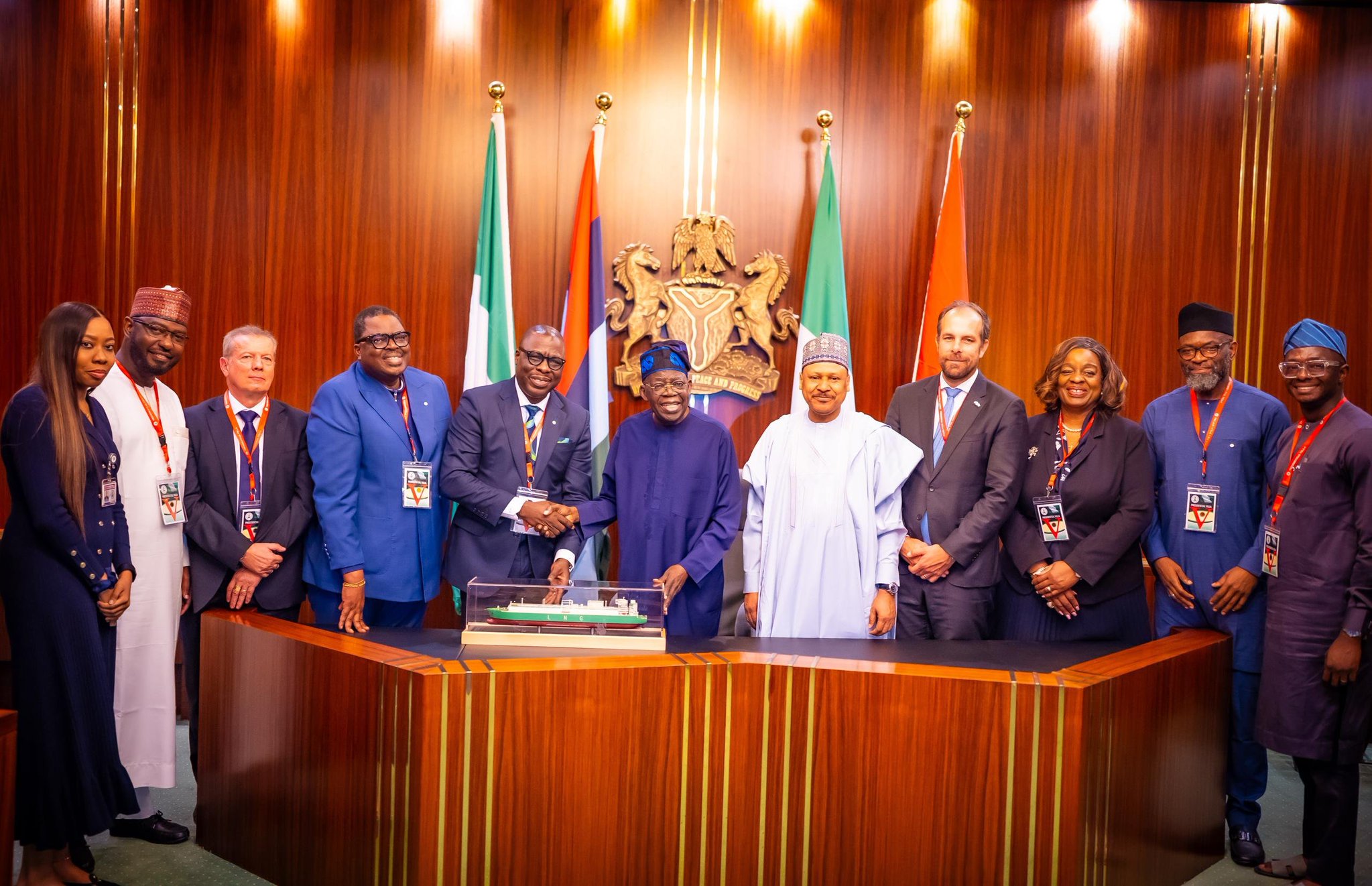
President Bola Ahmed Tinubu has urged the Nigeria Liquefied Natural Gas (NLNG) Limited to intensify efforts to reduce gas flaring and convert the country’s gas resources into economic benefits for Nigerians.
The President made the call on Wednesday at the State House, Abuja, when he received members of the NLNG Board, led by its Managing Director and Chief Executive Officer, Engineer Adeleye Falade.
Bayo Onanuga, Special Adviser to the President on Information and Strategy, disclosed this in a statement issued on Wednesday.
Tinubu said Nigeria must move beyond exporting gas and focus more on domestic utilisation, particularly in ways that would benefit consumers and support economic development.
“My major concern is the domestic utilisation, where you must be able to take out the flaring and convert potential environmental liability to what could be strategically and economically beneficial to the consumers in the country,” the President said.
He commended the NLNG management for increasing the company’s capacity and improving its operations, assuring the board of the Federal Government’s readiness to provide incentives that would stimulate further growth.
“If any other incentive is needed to stimulate growth and expand your capacity, I will be willing to do that,” Tinubu said.
The President stressed the need to ensure that Nigeria’s natural resources are fully harnessed for the benefit of the economy and the people.
“Whatever asset that we have in the ground is nothing unless it's brought up to service the economy, the people, and realisation of a good return on investment,” he said.
He also urged the NLNG to consider the needs of Nigerians in its operations, particularly the domestication of energy resources and pricing mechanisms that would make energy more affordable for ordinary citizens.
Earlier, Falade told the President that NLNG had generated more than $150 billion since its inception, with its shareholders, including the Nigerian government, receiving about $47 billion in dividends. Nigeria holds a 49 per cent stake in the company.
According to him, the company had previously operated at about 60 per cent capacity due to challenges in crude oil production, which limited operations to four of its six available trains.
He said increased oil production following positive developments in the oil and gas sector had enabled the company to raise its operational capacity to five trains, with further improvements expected.
Falade added that all of the company’s liquefied petroleum gas (LPG), commonly known as cooking gas, was currently being supplied to the domestic market.
He disclosed that NLNG was preparing to inaugurate Train Seven, which he said would increase the company’s capacity by 35 per cent and further strengthen its position in the global LNG market.
According to him, Nigeria LNG currently accounts for about five per cent of global LNG supply.
The NLNG chief executive also said the company’s shareholders had commended the stability in Nigeria’s fiscal environment, noting that it was helping to attract fresh investments into the country’s oil and gas sector.
He also praised security agencies and industry regulators for their roles in maintaining stability in the sector.
Falade further informed the President that the Bonny-Bodo Road and Bridge project, financed by NLNG, had been completed and was awaiting official commissioning.